Herb-Crusted Prime Rib
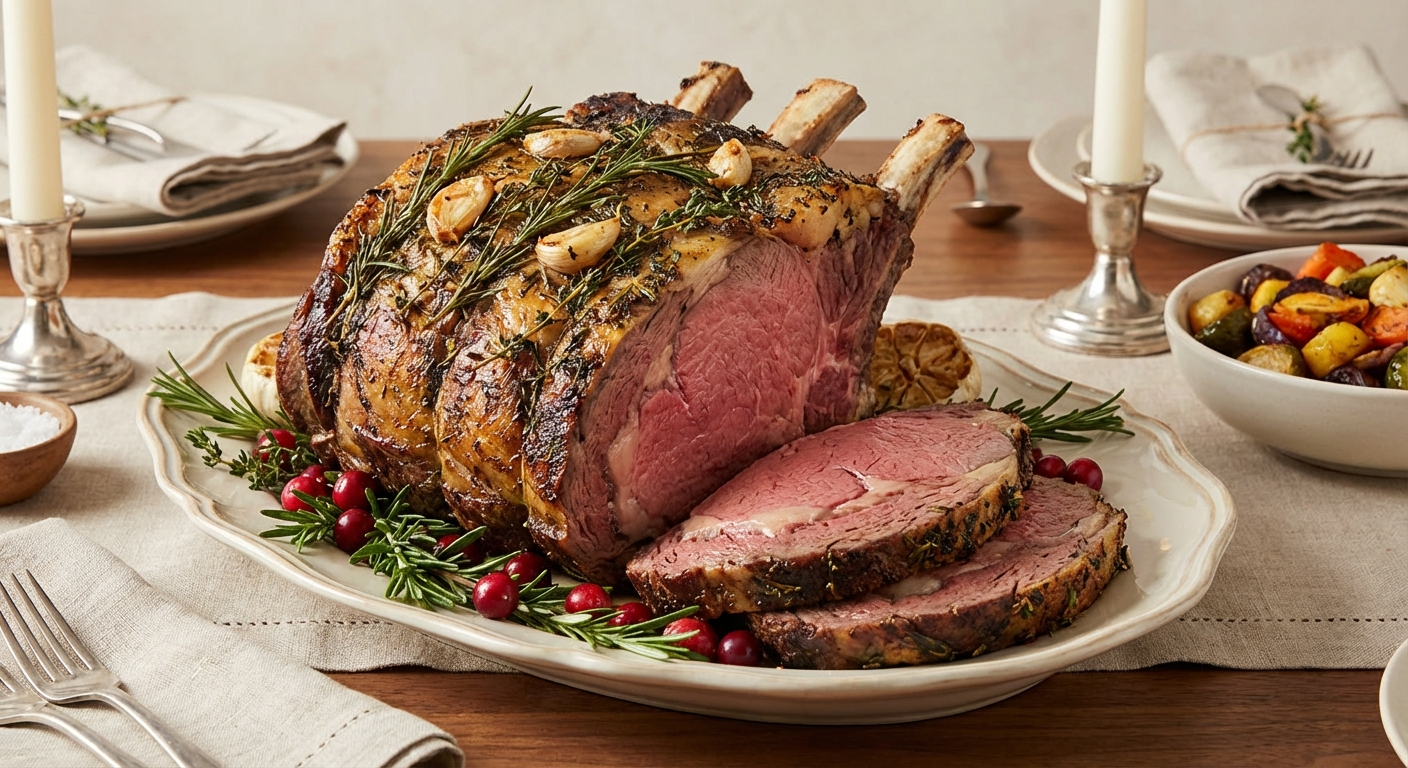
An impressive, restaurant-quality prime rib roast encrusted with a fragrant blend of fresh herbs, garlic, and Dijon mustard. Seared to develop a gorgeous crust, then slow-roasted to a perfect medium-rare. This is the ultimate Christmas dinner centerpiece for special occasions.
Ingredients
- 1 bone-in standing rib roast (7-8 pounds, about 4 ribs)
- 6 cloves garlic, minced
- 3 tablespoons fresh rosemary, finely chopped
- 2 tablespoons fresh thyme leaves
- 1 tablespoon fresh sage, finely chopped
- 3 tablespoons Dijon mustard
- 3 tablespoons extra-virgin olive oil
- 2 tablespoons coarse kosher salt
- 1 tablespoon freshly cracked black pepper
- 2 tablespoons softened butter
- 1 large onion, quartered
- 3 stalks celery, cut into large chunks
- 2 large carrots, cut into large chunks
- 1 cup dry red wine
- 2 cups beef stock
- 2 tablespoons all-purpose flour (for au jus, optional)
- 2 tablespoons cold butter (for finishing au jus)
Nothing says “special occasion” like a prime rib roast. It’s the dish that makes guests go quiet when you bring it to the table — that stunning herb-crusted exterior, the rosy pink interior, the rich aroma of rosemary and garlic filling the room.
Yes, it’s an investment. A quality prime rib roast isn’t cheap, and there’s real pressure to get it right. But here’s the secret: prime rib is actually one of the most forgiving roasts to cook, as long as you follow two rules — bring it to room temperature first, and use a meat thermometer. Do those two things and you’ll nail it every time.
This recipe delivers restaurant-quality results at home. The herb crust adds flavor and looks impressive, but the technique is straightforward. Let’s make this your best Christmas dinner yet.
This post contains affiliate links. We may earn a commission at no extra cost to you.
Essential Equipment
The right tools make prime rib foolproof:
- Instant-read meat thermometer — Non-negotiable. A Thermapen gives you accurate readings in 2-3 seconds so you never overcook.
- Leave-in probe thermometer — Even better: set it and forget it. The ThermoPro wireless alerts your phone when you hit your target temp.
- Heavy roasting pan — Needs to hold a 7-8 lb roast and go stovetop for the au jus. This stainless steel roaster is a workhorse.
- Carving set — A sharp carving knife and fork make slicing effortless. Wüsthof’s classic set will last decades.
- Cutting board with groove — Catches all those precious juices. A large wooden board looks beautiful for tableside carving too.
- Fat separator — Makes skimming the au jus easy. This OXO separator is the best design out there.
Instructions
Preparation (Day Before or Morning Of)
-
Remove the prime rib from the refrigerator and let it sit at room temperature for at least 2 hours before roasting. This is critical for even cooking — a cold roast will overcook on the outside before the center reaches temperature.
-
In a small bowl, combine the minced garlic, rosemary, thyme, sage, Dijon mustard, olive oil, softened butter, kosher salt, and black pepper. Mix into a thick paste.
-
Pat the roast dry with paper towels on all sides. This ensures the herb crust adheres properly and promotes better browning.
-
Rub the herb paste generously over the entire surface of the roast, pressing it into the meat. Cover the fat cap, the sides, and any exposed meat. For the best flavor, do this the night before, wrap loosely in plastic wrap, and refrigerate overnight.
Roasting
-
Preheat your oven to 450°F (230°C). Position a rack in the lower third of the oven.
-
Scatter the onion, celery, and carrots in the bottom of a heavy roasting pan. These vegetables serve as a natural rack and add flavor to the pan drippings for the au jus.
-
Place the prime rib bone-side down on top of the vegetables. The ribs act as a natural roasting rack.
-
Roast at 450°F for 20 minutes to sear the outside and develop the initial crust.
-
Reduce the oven temperature to 325°F (165°C) without opening the door. Continue roasting for approximately 15-17 minutes per pound for medium-rare.
-
Begin checking the internal temperature after about 1 hour and 45 minutes using an instant-read meat thermometer inserted into the thickest part of the roast, avoiding contact with bone or fat.
-
Remove the roast from the oven when the internal temperature reaches 120°F (49°C) for rare, 125°F (52°C) for medium-rare, or 130°F (54°C) for medium. The temperature will rise 5-10 degrees during resting.
Resting (Essential)
- Transfer the roast to a cutting board and tent loosely with aluminum foil. Let it rest for 20-30 minutes. This is not optional — resting allows the juices to redistribute throughout the meat, resulting in a juicier, more evenly colored roast.
Making the Au Jus
-
While the roast rests, place the roasting pan with the vegetables and drippings over medium-high heat on the stovetop (across two burners if needed).
-
Pour the red wine into the pan and scrape up all the browned bits from the bottom with a wooden spoon. Let the wine simmer and reduce by half, about 3-4 minutes.
-
Add the beef stock and bring to a simmer. Cook for 8-10 minutes, pressing on the vegetables to release their flavor.
-
Strain the liquid through a fine-mesh strainer into a saucepan, discarding the vegetables. For a thicker jus, whisk in the flour and simmer for 2-3 minutes.
-
Remove from heat and swirl in the cold butter for richness and a glossy finish. Season with salt and pepper to taste.
Carving and Serving
-
To carve, cut along the bones to separate the meat from the ribs in one piece. Slice the boneless roast crosswise into slices of your preferred thickness — about 1/2 inch for elegant portions or 3/4 inch for heartier servings.
-
Cut between the ribs to separate them for those who love gnawing on the flavorful bones.
-
Arrange the slices on a warm platter and serve with the au jus in a gravy boat on the side.
Tips
-
Buying your roast: Ask your butcher for a “first cut” or “loin end” rib roast (ribs 10-12), which is more uniformly shaped and has a larger eye of meat. Order in advance for Christmas, as prime rib sells out quickly.
-
The reverse-sear alternative: For even more control, you can roast at 250°F until the interior reaches your target, then blast it at 500°F for 8-10 minutes at the end for the crust.
-
Use a leave-in thermometer. A probe thermometer that stays in the meat while it cooks takes all the guesswork out. Set an alarm for 5 degrees below your target.
-
Doneness guide: Rare: 120°F (49°C), Medium-Rare: 125-130°F (52-54°C), Medium: 135°F (57°C). Most prime rib lovers prefer medium-rare for the best balance of tenderness and flavor.
-
Plan for leftovers. Cold prime rib makes extraordinary sandwiches. Slice thin, pile on crusty bread with horseradish cream and arugula.
-
Pair with: Creamy horseradish sauce, Yorkshire pudding, garlic mashed potatoes, roasted Brussels sprouts, or a bold Cabernet Sauvignon.
Buying Your Prime Rib
Grades matter: USDA Prime is the top tier (most marbling, most expensive), followed by Choice (excellent for most home cooks), then Select (leaner, less flavor). For Christmas dinner, Choice or Prime is worth the splurge.
Bone-in vs. boneless: Bone-in (standing rib roast) is traditional and many believe the bones add flavor. They also make a natural rack. Boneless is easier to carve but loses that dramatic presentation.
How much to buy: Plan for about 1 pound of bone-in roast per person, which yields roughly 1/2 pound of cooked meat per serving. For 8 guests, a 7-8 pound roast (4 ribs) is perfect.
Order ahead: Call your butcher at least a week before Christmas. Prime rib sells out fast, and the best butchers will dry-age your roast if you give them time — this concentrates flavor and improves tenderness.
What to Serve Alongside
Prime rib deserves sides that match its elegance:
- Garlic Mashed Potatoes — The classic pairing, perfect for soaking up au jus
- Roasted Brussels Sprouts — Crispy and caramelized, a perfect counterpoint to the rich beef
- Yorkshire pudding — Traditional British accompaniment that puffs up beautifully
- Creamed spinach — A steakhouse classic for good reason
- Horseradish cream — Mix prepared horseradish with sour cream and a pinch of salt
For wine, reach for a bold Cabernet Sauvignon, Malbec, or a Côtes du Rhône. The tannins cut through the richness of the beef.
Get Christmas recipes in your inbox
New holiday recipes every week during the Christmas season.