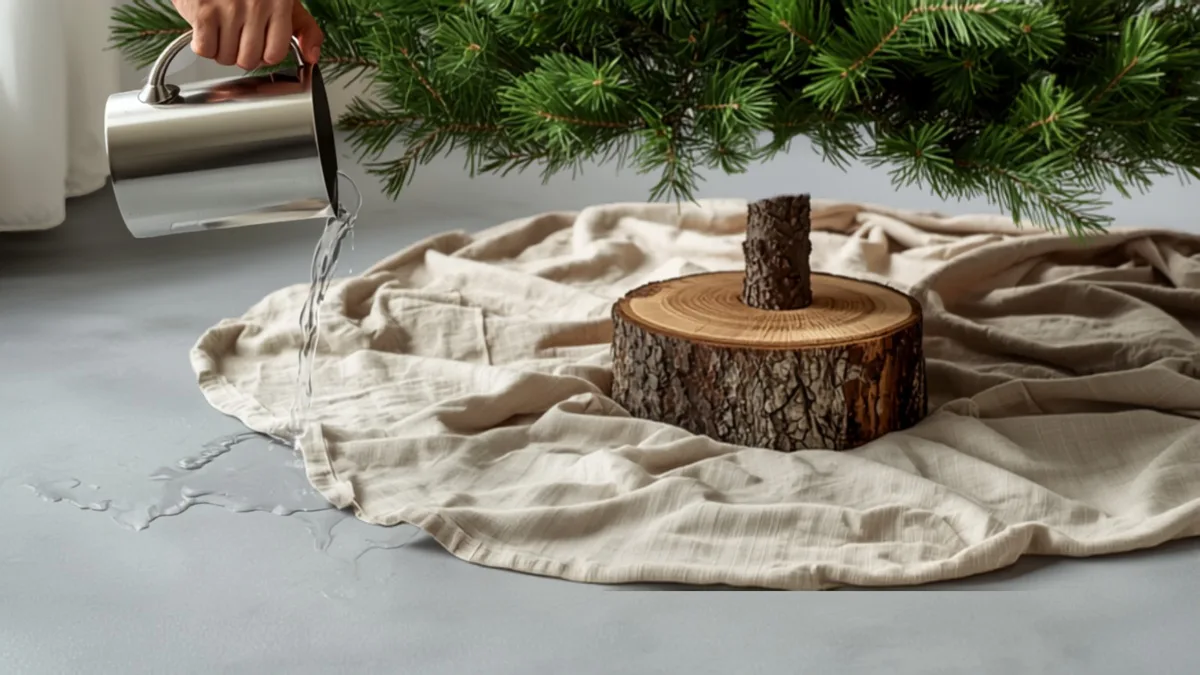
Every year, tens of millions of households buy a severed conifer and then argue about how to keep it from dying, using folklore inherited from grandparents: aspirin in the water, sugar in the water, bleach, lemonade, vodka. Meanwhile the tree — which is not a decoration but a large cut flower — quietly obeys plumbing rules that were worked out by botanists long ago and that almost nobody applies.
The good news is that the actual science is simple, cheap, and mostly about the first two hours after you buy the tree. Get those right and a fresh fir will hold its needles into January. Get them wrong and no additive on earth will save it.
A Tree Is a Column of Water
A living conifer is, hydraulically, a bundle of microscopic straws. Water enters at the roots and is pulled up through the xylem — dead, hollow, pipe-like cells — by the suction created as water evaporates from the needles. There is no pump. The whole system runs on evaporation at the top and an unbroken column of water in the middle, held together by the cohesion of water molecules.
Cut the trunk and two things happen. First, the tree loses its supply but keeps evaporating: a fresh cut tree in a living room is losing water constantly through hundreds of thousands of needles, and a typical tree will drink on the order of a quart of water per day for every inch of trunk diameter — a gallon a day for a four-inch trunk is normal in the first week. The figure surprises everyone the first time they own a proper stand.
Second, and this is the part the folklore misses, the cut surface starts sealing itself. Air is drawn into the exposed xylem, breaking the water columns — botanists call it embolism — and the tree’s own resin begins covering the wound. Within a few hours of a cut being exposed to air, the bottom of the trunk is effectively waterproofed. A sealed tree stood in a full stand of water takes up almost nothing and dries from the top down, invisibly at first.
Everything practical follows from those two facts.
The Two Hours That Decide Everything
Get a fresh cut. Any tree that was harvested more than a few hours before you take it home — which at a retail lot means every tree — has a sealed base. Take a half inch to an inch off the bottom, in a straight cut, immediately before the tree goes into water. Most lots will do this for you; the cut is only useful if the trunk goes into water within a couple of hours, before it seals again. Cutting at an angle or drilling holes does not help — uptake happens through the freshly exposed straws, and an angled cut just makes the tree harder to seat in the stand.
Get it into water fast, and never let the stand go dry. This is the entire secret, and it is a one-strike rule: if the water level ever drops below the cut, the base seals, uptake collapses, and topping the stand back up will not fully reverse it. Check the water twice a day for the first week — that is when drinking is heaviest — and once a day after. A stand should hold at least a quart of water per inch of trunk diameter, which rules out the tiny bowls on cheap stands.
Plain water. Nothing else. This is where the science is most satisfying, because it has actually been tested. Researchers and extension services have run the folk additives — aspirin, sugar, bleach, commercial “tree preservative” powders, soft drinks, vodka — against plain tap water, measuring needle retention and moisture content. Plain water wins or ties essentially every time, and some additives (bleach, and anything acidic) measurably worsen things. The persistent aspirin theory misunderstands the problem: the tree is not in pain, it is embolised. Water it.
Species Is Half the Battle
No amount of care makes a Norway spruce behave like a Fraser fir. Needle retention after cutting varies enormously by species, and it is the single biggest choice you make.
The firs are the champions. Fraser fir — the dominant premium tree in North America — holds needles four to five weeks with decent care, which is why it gets shipped worldwide. Noble and Nordmann fir are similarly tenacious; the Nordmann’s thick, glossy, almost plastic-feeling needles are the reason it has taken over the European market. Balsam fir trades a little retention for the strongest fragrance of the group.
Pines — Scots and white — hold needles well but have floppier branches that dislike heavy ornaments. The heartbreakers are the spruces: Norway spruce, the classic tree of European Christmases, can start shedding within a fortnight indoors, which is fine if you buy on December 15 and ruinous if you buy in November. If your tree needs to stand for five weeks, buy a fir; the decorating will survive contact with the branches either way.
Freshness at purchase matters as much as species. Run a branch through your hand — green needles should flex, not shower off. Lift the tree a few inches and tap the butt on the ground: losing some interior brown needles is normal, losing green ones from the outer branches is a tree that has already dried past saving.
Slowing the Evaporation Side
Uptake is one half of the equation; loss is the other. A tree in a 22°C room with dry central heating is transpiring hard, and everything that lowers the demand extends its life.
Position does the most: away from radiators, wood stoves, fireplaces and heating vents, and out of direct sun. Cooler rooms genuinely help — the difference between a tree beside a radiator and one in a cool corner can be weeks. Humidity helps too; winter indoor air is desert-dry, and a humidifier in the tree’s room slows needle loss (and is kinder to your sinuses). Letting a netted tree stand in water in a cool garage for a day before bringing it in — with its fresh cut already made — lets it rehydrate before facing the living room.
Lights matter more than people think, for the same reason. Old incandescent strings were small heaters draped through the branches, drying the tree from inside the canopy. LEDs run close to cold, use a fraction of the power, and are one of the few genuine upgrades in this whole subject: cooler tree, lower fire load, and no hunting for the one dead bulb that kills the string.
The Fire Question, Honestly
Christmas tree fires are rare and severe — that is the accurate summary. US fire services attend a couple of hundred of them in a typical year, a rounding error among house fires, but they are disproportionately deadly, roughly one death per fifty fires against one per hundred-plus for house fires generally, because a dry tree is close to the perfect fuel: enormous surface area, resinous, standing in the middle of a furnished room.
The famous side-by-side burn demonstrations — a watered tree and a dry tree, each touched with the same flame — are worth thirty seconds of anyone’s time. The watered tree chars and self-extinguishes. The dry tree is fully involved in under thirty seconds, with the room beyond it igniting shortly after. The variable is nothing but water content, which is to say: everything above about keeping the stand full is also the fire-safety advice. Add the obvious rest — no candles on or near the tree, lights off overnight and when out, and the tree gone from the house once it is shedding heavily, because a dead tree drying in a January living room is the highest-risk configuration of the whole season.
The Short Version
Buy a fir, fresh, and do the branch test. Take an inch off the base and get it into water within two hours. Big stand, plain water, checked daily, never dry. Cool spot, away from heat, LEDs on it. Done by December 1, that routine reliably delivers a tree that is still presentable — and still safe — on Twelfth Night. If that sounds like more custody than you want, there is no shame in the other route; we’ve compared the real and artificial options honestly, cost, scent, and environmental footprint included.
The tree cannot be saved. It was cut. But it can be kept magnificent for six weeks by anyone willing to treat it as what it is — the largest cut flower you will ever own.
Liked this? There's one of these every week.
Christmas guides, recipes and gift ideas, written the same way — straight to your inbox.
🎄 You're in! Check your inbox to confirm.
Something went wrong. Please try again.