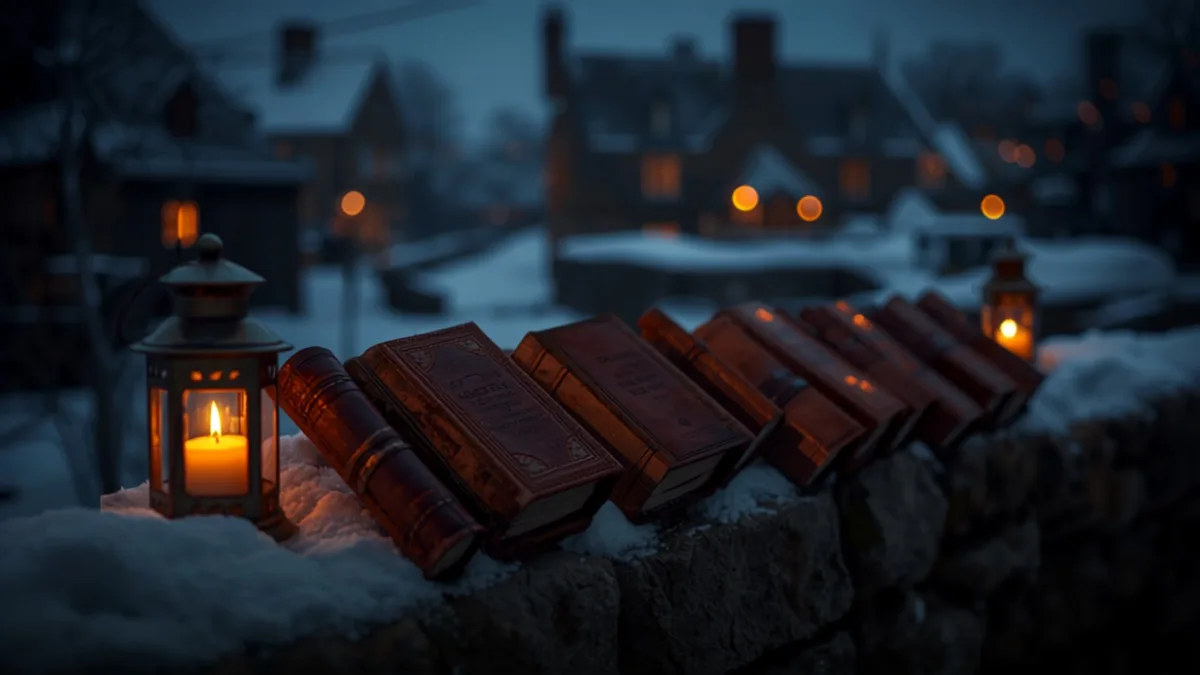
Carols feel permanent, like weather. They arrive every December apparently from nowhere, everyone knows the words without ever having learned them, and it seems impertinent to ask where they came from.
Ask anyway, because the answers are consistently stranger than the songs. The most famous carol in the world premiered on a guitar in a village church and the reason usually given is probably folklore. The tune of another was written for a printing-press anniversary by a composer who explicitly said it should never carry sacred words. A third isn’t a Christmas song at all. Behind the candlelit surface, carol history is full of accidents, arguments and outright hijackings — which is fitting, because the carol itself began as something the church wanted stopped.
First, What a Carol Actually Is
The word comes from the medieval carole — a circle dance with singing, secular and none too solemn. Carols were the popular music of the medieval winter: danced, sung in homes and streets, only loosely attached to church. Alongside them ran wassailing, the older custom of singing door to door in exchange for drink and food — less “angelic choir,” more “organised begging with harmonies,” and the direct ancestor of modern carolling. The begging survives politely in “We Wish You a Merry Christmas,” which is essentially a demand for figgy pudding with a threat (“we won’t go until we get some”) still attached.
Puritan disapproval in the seventeenth century drove carols out of English churches and nearly out of existence; they survived orally and on cheap printed broadsides. What saved them was Victorian antiquarianism: collectors like Davies Gilbert (1822) and William Sandys (1833) published the old texts before they vanished — Sandys’s collection gave “The First Noel” and “I Saw Three Ships” their standard forms — and the hugely successful Christmas Carols New and Old (1871) put carols back into churches that had spent two centuries keeping them out. Almost everything we now think of as timeless passed through that Victorian bottleneck.
Silent Night: The Broken Organ That Probably Wasn’t
The facts are secure. Joseph Mohr, a young assistant priest, wrote the six-verse German poem “Stille Nacht” in 1816 in Mariapfarr. Two years later, in the village of Oberndorf near Salzburg, he brought it on December 24, 1818, to Franz Xaver Gruber, the schoolmaster-organist of St. Nicholas church — the saint again — and asked for a melody for two voices, choir and guitar. It was performed that night, the two men singing over Mohr’s guitar. A manuscript in Mohr’s own hand, discovered in the 1990s, settled the authorship permanently and confirmed the guitar arrangement.
The guitar is the puzzle, and the beloved explanation — the church organ was broken, in the best-known telling because mice had eaten the bellows — has no contemporary evidence behind it. The organ story appears decades later and grows more detailed with each retelling, which is how folklore behaves. The simpler possibilities are that Mohr simply liked the guitar, or that the gentle 6/8 lullaby was written for it. Nobody knows, and “nobody knows” has never once stopped the mice story being told.
What happened next was viral spread, nineteenth-century style: an organ builder carried the song to Tyrolean valleys, and travelling family singers — the Rainers and the Strassers, folk groups who toured Europe and America — performed it everywhere, often billed as an anonymous “Tyrolean folk song.” Gruber spent years politely insisting he had written it. By century’s end it was global; in 1914 it was reportedly among the carols sung across the trenches during the Christmas truce, one of the few songs both sides knew; in 2011 UNESCO listed it as intangible cultural heritage. Not bad for two verses, a schoolteacher and a guitar.
Hark! The Herald Angels Sing: Assembled Against Both Authors’ Wishes
No carol is more thoroughly a committee product — with the committee overruling everyone involved.
Charles Wesley wrote the words in 1739, and his opening line was “Hark how all the welkin rings” — welkin being an already-archaic word for the heavens. Wesley’s colleague and rival George Whitefield rewrote it in 1753 to “Hark! the herald angels sing,” which scans better and means less (herald angels are not a thing in scripture; angels are heralds). Wesley, for his part, disliked having his hymns altered, and had specified solemn music for it.
The tune came from somewhere else entirely. In 1840 Felix Mendelssohn wrote a cantata for the Leipzig festival marking 400 years of Gutenberg’s printing press. Of its second movement he later remarked, in effect, that the music would suit lively secular words but would never do for sacred ones. In 1855 — Mendelssohn safely dead — the English organist William Cummings bolted Wesley’s rewritten words onto Mendelssohn’s printing-press tune. The result: a hymn whose lyricist wanted different words and solemn music, set to a melody whose composer said it must never carry sacred text, which is now sung by candlelight in every English-speaking church on earth. It is, admittedly, a perfect fit.
Jingle Bells: Not Actually a Christmas Song
Nothing in “Jingle Bells” mentions Christmas. No nativity, no Santa, no holiday of any kind — it is a song about young men racing sleighs and flirting, with a verse about crashing into a snowbank that nobody sings anymore.
James Lord Pierpont published it in 1857 as “The One Horse Open Sleigh,” and the persistent claim that he wrote it for a Thanksgiving service comes with a bonus dispute: both Medford, Massachusetts and Savannah, Georgia claim it was written in their town, and both have historical markers saying so. Medford has the sleigh races; Savannah has the publication date and Pierpont’s residence. The feud, like Riga and Tallinn’s over the tree, is comfortably permanent.
Pierpont himself is a gift to anyone who thinks carol composers were gentle souls: nephew of the financier J. P. Morgan’s namesake grandfather and son of a fervent abolitionist minister, he went south, took the Confederate side in the Civil War, and wrote Confederate anthems — the author of “Jingle Bells” and “We Conquer or Die” are the same man. The song drifted into the Christmas repertoire because winter songs had nowhere else to live, and picked up one last distinction in December 1965, when the crew of Gemini 6 reported a UFO — “a satellite going from north to south, probably in polar orbit… I see a command module and eight smaller modules in front” — then played “Jingle Bells” on a smuggled harmonica and sleigh bells: the first song performed in space.
O Come, All Ye Faithful: Possibly a Coded Battle Hymn
For two centuries “Adeste Fideles” was attributed to everyone from medieval monks to the King of Portugal. The manuscripts point to John Francis Wade, an English Catholic who fled to France after the failed Jacobite rising and made his living copying liturgical music. The earliest copies are in his hand, from the 1740s — and several are decorated with Jacobite imagery.
Which raises the theory, argued seriously by some scholars: that the hymn doubles as a coded rallying cry, with “faithful” meaning the Catholic Jacobite faithful, and the call to Bethlehem a veiled call to England — “born the King of angels” carrying a second meaning for the exiled Bonnie Prince Charlie. The evidence is circumstantial and the mainstream view keeps it as an open possibility rather than a fact. But it would make the carol bellowed loyally in Anglican churches every December a smuggled anthem for overthrowing the Anglican settlement, which is either history’s best irony or its best coincidence.
Why the Stories Matter
Run the pattern across all five and it is the same one: a song escapes its author, its occasion and frequently its meaning, and the version that survives is the one the crowd chose. Wesley lost his welkin, Mendelssohn lost his embargo, Gruber spent decades reclaiming his own melody, and Pierpont’s sleigh-racing song was adopted by the very holiday it never mentioned. Carols are folk property that happen to have authors.
That is also why they feel like weather. They were sanded smooth by millions of singers before any of us arrived. If this has left you wanting the deeper catalogue — who wrote what, which came from where, and what the second verses everyone skips actually say — our full guide to Christmas songs and carols takes each one in turn.
Liked this? There's one of these every week.
Christmas guides, recipes and gift ideas, written the same way — straight to your inbox.
🎄 You're in! Check your inbox to confirm.
Something went wrong. Please try again.