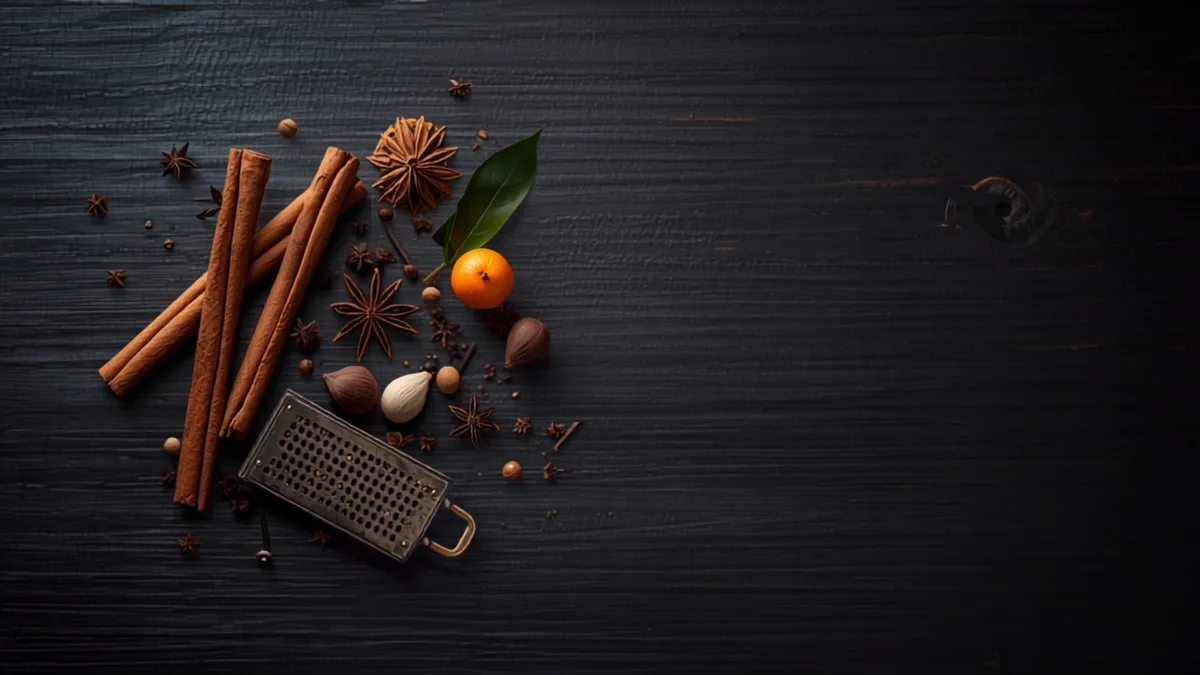
Here is something odd about Christmas flavour: none of it is seasonal.
Cinnamon is the inner bark of a tree from Sri Lanka. Cloves are unopened flower buds from the Maluku islands. Nutmeg comes from a single small archipelago in the Banda Sea. Ginger is a rhizome from southern Asia. Not one of these plants has ever grown within two thousand miles of a northern European winter, and none of them has a December harvest that would matter if it did.
Compare that to the rest of the Christmas table, which is genuinely seasonal — the goose fattened through autumn, the root vegetables that store, the last of the apples, the pig killed because it could not be overwintered. The meat and vegetables are dictated by the calendar. The flavour is not.
So why does a mince pie taste like December? The answer has three parts: what these compounds do to your nervous system, what they cost, and what your brain does with a smell it only meets once a year.
Part One: They Are Not Warming. They Just Feel Like It
Every food writer describes Christmas spices as “warming”. This is usually treated as poetry. It is closer to pharmacology.
Your mouth and skin carry a family of receptors that detect temperature and chemical irritation. Two matter here:
- TRPV1 — the receptor that responds to actual heat above roughly 43°C, and also to capsaicin, the compound in chilli. This is why chilli feels hot: it is not raising your temperature, it is opening the channel your body uses to report burning.
- TRPA1 — a related channel, triggered by cold and by a long list of pungent plant compounds, including cinnamaldehyde in cinnamon, eugenol in cloves and allspice, and the isothiocyanates in mustard and horseradish.
Ginger’s gingerol and, in dried ginger, the more pungent shogaol produced when it is dried, act on TRPV1 — the chilli receptor. This is why dried ginger has a genuine bite that fresh ginger does not, and why gingerbread has heat rather than just aroma.
So the “warmth” of these spices is not a metaphor and not a memory. Your trigeminal nerve is reporting heat because the chemical has opened the same gate that real heat opens. Christmas spices are, physiologically, mild counterfeits of a fire.
Which is a fairly remarkable thing for a culture at that latitude to have selected for. Northern Europeans acquired, at enormous expense, a set of imported compounds whose principal shared property is that they simulate warmth — and then concentrated their use in the coldest, darkest weeks of the year.
There is also a genuine functional reason underneath the sensory one. Many of these compounds are antimicrobial, which is not incidental for foods designed to sit for weeks. Eugenol in particular has real preservative activity. The spices that make a Christmas pudding taste of Christmas are part of why a Christmas pudding keeps.
Part Two: They Were Absurdly Expensive
The second reason Christmas tastes like this is that Christmas is the feast, and the feast is where you display what you have.
For most of European history these spices were among the most valuable goods in existence. They travelled through a chain of intermediaries — Malabar and the Malukus, Arab and Gujarati traders, Venice — with each link taking its margin. A pound of cloves might cost a labourer weeks of wages.
The result is a straightforward equation: spice equals status. And the single occasion on which a household displayed its status through food was the midwinter feast. Spiced food was rich food, and rich food was Christmas food, and the association held long after the price collapsed.
The history that produced that price is uglier than the aroma suggests, and worth knowing.
Nutmeg grew, until the nineteenth century, essentially only on the Banda Islands — ten volcanic specks in the Banda Sea, total area smaller than many cities. That monopoly made them the most contested real estate on earth. The Dutch East India Company took control in 1621 under Jan Pieterszoon Coen in a campaign that destroyed the Bandanese population through massacre, starvation and enslavement; the islands were repopulated with enslaved labour to work the groves.
One island, Run, was held by the English. Under the Treaty of Breda in 1667, England formally relinquished Run to the Dutch in exchange for keeping a New World settlement it had taken called New Amsterdam — since renamed Manhattan. The trade was not the lopsided joke it is often presented as: at the time, an island that produced nutmeg was a plausible thing to want more than a harbour town. But it is the cleanest illustration available of what these flavours were once worth.
Cloves came from Ternate and Tidore in the Malukus, and were subject to the same monopoly logic — the Dutch destroyed clove trees outside their controlled zones to hold the price up.
So the warm, comforting, domestic smell of a studded ham or a mulled wine has, underneath it, several centuries of monopoly, war and slavery. That does not spoil the mince pie. But the fact that this particular flavour set became the taste of generosity and family is one of history’s blacker ironies, and it is better known than not.
Part Three: Why It Only Tastes Like Christmas If You Ration It
Here is the part that explains why the same spices do not taste like Christmas in Delhi or Marrakesh.
Smell is anatomically peculiar. Most sensory information routes through the thalamus before reaching the cortex. Olfactory signals largely bypass that, passing from the olfactory bulb into structures closely tied to memory and emotion — the piriform cortex, the amygdala, the hippocampus. Odour memories tend to be older, more emotionally loaded, and harder to put into words than visual ones. This is the mechanism behind the involuntary rush of recollection that a smell can produce.
Now add the crucial variable: restriction.
In cultures where cinnamon appears in savoury cooking year-round, cinnamon does not signify a season. In northern Europe and North America, these spices were, for a long time, concentrated into a few weeks. A child encounters that smell in a specific place, at a specific time, surrounded by specific people, with heightened anticipation — and encounters it only then. That is close to an ideal condition for forming a strong, durable, emotionally weighted association.
The flavour does not carry Christmas inherently. It carries whatever you reliably attached to it, and the reliability is doing the work.
Which has a practical implication most people get wrong. If you want gingerbread to feel like Christmas, do not bake it in July. The seasonality is not a limitation of the recipe. It is the active ingredient. Every year you spread these flavours across the calendar, you spend a little of the thing that makes them work in December.
What Else Is Doing the Work
Spice is the headline, but three other mechanisms are in play.
The Maillard reaction. Browning is not caramelisation — caramelisation is sugar alone. The Maillard reaction is between amino acids and reducing sugars, it accelerates above roughly 140°C, and it generates hundreds of new aroma compounds that were not in the raw ingredients. The crust on the roast, the top of the gingerbread, the edge of the mince pie, the skin on the goose: all Maillard, and all producing the deep savoury-sweet notes that no amount of spice can supply on its own. This is why a pale roast tastes thin regardless of seasoning, and it is why drying the skin before roasting matters more than most people think.
Sugar and alcohol as preservatives. The classic Christmas sweets are all high-sugar, high-alcohol, low-water: Christmas pudding, fruitcake, stollen, mincemeat. This is not a coincidence of taste. Sugar and spirit both reduce water activity and inhibit microbial growth. These are engineered keeping foods, developed when winter meant months without fresh produce, and the practice of feeding a cake with brandy over weeks is preservation first and flavour second. It also explains why a proper Christmas cake is made in October: it needs the time.
Mincemeat really did contain meat. The name is not vestigial. Medieval and early modern mincemeat was minced meat, combined with dried fruit, spice and suet — the sweet-savoury combination being standard in a period that did not divide courses the way we do. The meat faded out over the eighteenth and nineteenth centuries, but suet stayed, which is why traditional mincemeat is still not vegetarian unless it says so.
Citrus is genuinely seasonal. The orange in the toe of the stocking is the one part of the Christmas flavour palette with a real calendar behind it. Mediterranean citrus ripens in winter, and an orange in a northern December was an exotic, perishable, expensive thing that had travelled a long way to arrive exactly then. Of everything on this list, it is the only flavour that is in season because it is in season.
Building a Table That Uses This
A few things follow from all of the above, if you cook.
Bloom your spices. Cinnamaldehyde, eugenol and their relatives are fat-soluble and volatile. Warming ground spice briefly in butter or oil, or toasting whole spice before grinding, extracts far more aroma than stirring powder into a cold batter. The difference is not subtle.
Grate nutmeg fresh. Nutmeg loses its volatiles faster than almost any other spice; pre-ground nutmeg more than a few months old is close to inert. It is the single highest-return change in Christmas baking. (Also: nutmeg contains myristicin and is genuinely toxic in large quantities — we are talking tablespoons, not the pinch a recipe calls for, but it is a real effect rather than folklore.)
Give the keeping foods their time. A pudding or a cake made in October and fed periodically is a different object from one made on December 20. The chemistry needs weeks.
Get the browning right before you worry about seasoning. Dry the skin, get the oven hot enough, do not crowd the tin. Maillard is doing more of the work than the spice rack.
Our Christmas recipes section has all of this applied — the drinks for mulled wine and its spicing, the desserts for puddings and cakes with the make-ahead timings, and the Christmas dinner menu for the whole thing scheduled backwards from when you want to eat.
The Short Version
Christmas flavour is not seasonal. Cinnamon, clove, nutmeg and ginger are tropical, harvested at the wrong time of year, and grown nowhere near the cultures that made them the taste of midwinter.
They feel warm because they genuinely trigger the heat and irritation receptors — TRPV1 and TRPA1 — that report actual burning. A culture in the cold and dark selected, at great expense, for compounds that counterfeit a fire.
They became festive because they were expensive, and the feast is where expense is displayed. That expense rested on monopolies enforced with real violence, most starkly in the Banda Islands.
And they still taste like Christmas only because they are rationed to Christmas. Odour is wired close to memory and emotion, and a smell encountered in one context, once a year, in childhood, becomes a very durable key to that context.
Which means the tradition is self-maintaining, and also fragile in an interesting way. The flavour has no intrinsic Decemberness. It has yours.
Liked this? There's one of these every week.
Christmas guides, recipes and gift ideas, written the same way — straight to your inbox.
🎄 You're in! Check your inbox to confirm.
Something went wrong. Please try again.